Losing a tooth can affect more than the appearance of your smile. A missing tooth may make chewing more difficult, affect speech, and allow neighboring teeth to shift into the empty space.
Fortunately, several dental treatments can replace missing teeth. Two commonly considered options are dental bridges and dental implants. Although both can restore the appearance and function of a smile, they work in different ways and are not appropriate for every patient.
Understanding how dentists approach these options can help you have a more informed conversation about replacing a missing tooth.
What Is a Dental Bridge?
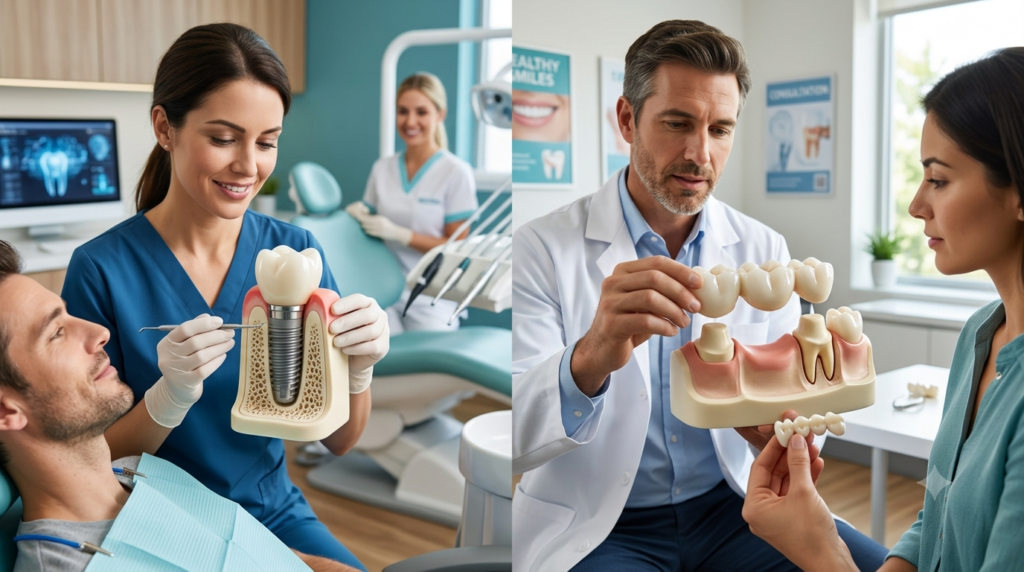
A dental bridge is a fixed restoration designed to fill the space created by one or more missing teeth. The replacement tooth, known as a pontic, is supported by neighboring teeth or, in some cases, dental implants.
Traditional bridges typically use crowns placed over adjacent teeth to hold the replacement tooth securely in position.
Dental bridges can help:
- Fill the visible gap left by a missing tooth
- Restore chewing function
- Improve speech
- Prevent nearby teeth from shifting
- Improve the overall appearance of the smile
Vaani Dental offers different types of bridges, including traditional fixed, cantilever, and Maryland bridges, depending on the patient’s needs.
What Is a Dental Implant?
A dental implant replaces the missing tooth from the root upward. A small implant is placed into the jawbone and allowed to integrate with the surrounding bone. A restoration is then attached to the implant to replace the visible portion of the tooth.
Unlike a traditional bridge, an implant does not rely on neighboring natural teeth for support.
Dental implants may be used to replace:
- A single missing tooth
- Several missing teeth
- Multiple teeth as part of an implant-supported restoration
- Teeth as part of a full-arch treatment plan
Vaani Dental also provides implant-supported overdentures and advanced implant treatment options.
How Are Bridges and Implants Different?
The main difference is how the replacement tooth is supported.
A traditional dental bridge uses neighboring teeth as anchors, while a dental implant is anchored directly into the jawbone.
Because of this difference, the dentist must consider several factors before recommending either option.
These may include:
- The number of missing teeth
- The condition of neighboring teeth
- Jawbone health
- Gum health
- The location of the missing tooth
- Your bite and chewing forces
- Your overall oral health
- Your long-term treatment goals
There is no single solution that is right for every missing tooth.
When Might a Dental Bridge Be Considered?
A bridge may be an appropriate option when the teeth surrounding the missing space are healthy enough to provide support.
It can also be useful for patients who want a fixed replacement without undergoing implant placement.
Bridges can often restore the appearance and function of a missing tooth while preventing neighboring teeth from moving into the open space.
The type of bridge selected depends on the location of the missing tooth, the surrounding teeth, and the patient’s individual needs.
When Might a Dental Implant Be Considered?
Dental implants may be considered when a patient wants a replacement that does not depend on neighboring teeth for support.
Because the implant is placed into the jawbone, it can provide a stable foundation for a crown or other restoration.
However, implant treatment requires careful evaluation. Your dentist may assess the amount and condition of available bone, the health of your gums, and other factors before determining whether an implant is appropriate.
In more complex cases, additional treatment may be needed before implant placement.
Do Dental Bridges and Implants Look Natural?
Both bridges and implants can be designed to blend with the surrounding teeth.
The final appearance depends on factors such as the restoration’s shape, size, shade, position, and the health of the surrounding tissues.
A properly planned restoration should complement your existing smile rather than simply fill the empty space.
How Long Does Treatment Take?
Treatment time can vary depending on the option selected and the condition of your mouth.
A dental bridge may require preparation of the supporting teeth followed by impressions or digital scans and placement of the final restoration.
Implant treatment generally involves more stages because the implant needs time to integrate with the jawbone before the final restoration is placed.
Your dentist can provide a more specific timeline after evaluating your individual situation.
How Do Dentists Decide Between a Bridge and an Implant?
The decision is not based only on which treatment is more popular. Dentists consider the overall condition of your mouth and how each option fits your needs.
During an evaluation, your dentist may examine:
- The missing tooth or teeth
- Neighboring teeth
- Gum health
- Jawbone condition
- Bite alignment
- Existing dental restorations
- Your oral hygiene
- Your treatment goals
A personalized treatment plan can help determine whether a bridge, implant, or another tooth-replacement option is most appropriate.
What Happens If a Missing Tooth Is Not Replaced?
Leaving a missing tooth untreated can allow neighboring teeth to shift toward the empty space. This may affect your bite and make cleaning certain areas more difficult.
Depending on the location of the missing tooth, the change may also affect chewing or speech.
Replacing the tooth can help restore function and maintain a more balanced smile.
Which Option Is Right for You?
Dental bridges and implants can both provide effective ways to replace missing teeth, but they are not interchangeable treatments.
A bridge may be a practical choice when neighboring teeth can provide support, while an implant may be considered when a patient wants a replacement supported within the jawbone.
The best option depends on your oral health, the condition of the surrounding teeth and bone, the number of missing teeth, and your long-term goals.
If you are living with a missing tooth and are unsure whether a dental bridge or implant is right for you, schedule a consultation with Vaani Dental. A comprehensive evaluation can help you understand your tooth-replacement options and choose an approach designed around your smile, comfort, and oral health.
